A Breakthrough Gets You Approved. An Economic Case Gets You Reimbursed.
Obesity drugs are saving healthcare costs. Just not enough to pay for themselves, yet. What CVS Health’s $350 break-even number tells pharma about how we measure value.

Four things worth knowing before the detail
The drugs save money. Not enough, at today’s prices.
Over three years, each patient generated $9,400 less in medical spending but $13,300 more in prescription spending. The plan paid $3,900 more per person.
The gap is about 29%, not 70%
If use stays the same, net drug spend needs to fall by roughly 29% to break even. That is a negotiation, not a different planet.
Cost-effective and cost-saving are two different tests
By the classic health economics test, these drugs already pass. By the payer’s budget test, they do not. Pharma argues on the first. Payers decide on the second.
Persistence is part of the price
The plan pays for the drug every month. The savings arrive later. A patient who stops early costs money and delivers almost none of the return.
00The number on the table
On 15 November 2026, CVS Health released a real-world study on GLP-1 medicines, covering Ozempic, Mounjaro, Wegovy and Zepbound, using Aetna commercial claims. People who started a GLP-1 between 2023 and 2025 were matched with similar non-users on age, health conditions, past use of care and past spending, and followed for up to three years.
The health story is strong. Emergency room visits were 10 to 12% lower in the first and second year. Hospital admissions were 34 to 42% lower after three years.
The money story is not there yet. Over three years, each patient generated $9,400 less in medical spending, but $13,300 more in prescription spending. Net result: the plan paid $3,900 more per person.
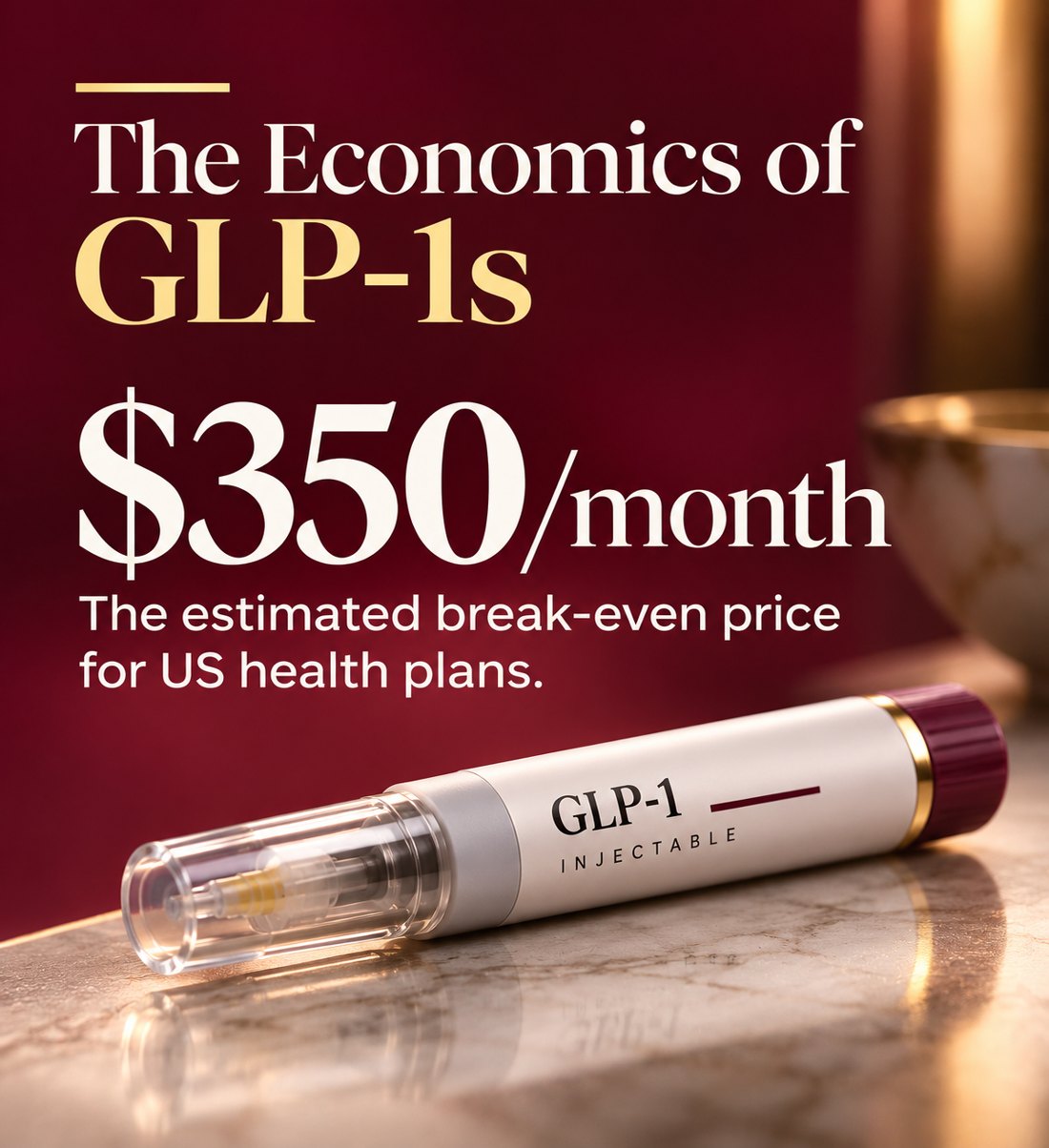
CVS modelled that a net price of roughly $350 a month would bring drug spending and medical savings into balance. Today, employers and plans typically pay around $617 to $766 a month, based on a 2025 EBRI study cited by Reuters.
CVS’s own conclusion was balanced: break-even should not be the only measure of a medicine’s value. But the market is already acting on the gap. About 14% of companies have dropped or plan to drop GLP-1 coverage in 2027, and CVS’s chief executive said in July that the economics simply are not there yet.
01Read the gap correctly
Before we jump to “the drugs are too expensive,” three things are worth slowing down for.
The gap is smaller than the headlines suggest. $9,400 divided by $13,300 is about 71%. If use stays the same, net drug spend needs to fall by roughly 29% to break even. Entry-level cash prices for Zepbound and Wegovy already sit around $299 to $349 a month. The price CVS is asking for already exists in the market. The question is which channel, which patients and which terms.
Cost-effective and cost-saving are two different tests. In late 2025, ICER, the US independent value body, concluded that semaglutide and tirzepatide are already cost-effective for obesity at net prices of about $6,830 and $7,973 a year. That is roughly $570 to $660 a month, and ICER’s value-based price ranges were even higher. So by the classic health economics test, the price is fine. By the payer’s budget test, it is not. That mismatch is the real story.
Break-even depends on whose budget and which patients. A University of Chicago team estimated that for Medicare covering people with obesity who do not yet have diabetes or heart disease, the cost-neutral price over ten years is about $185 a month. CVS’s mixed commercial population, which includes people with diabetes, breaks even at about $350. Same drugs, nearly double the break-even price, because the patient mix is different. There is no single right price for a GLP-1. There is a right price for a defined population.
The question is not only “is the price too high?” It is “what are we measuring, over what time, and for whom?”
02Three commercial implications
For anyone running a brand or an access strategy in this class, or in any high-volume chronic medicine that will face the same question next.
Three implications
Patient selection matters
The higher the patient’s risk, the sooner savings appear. A focused value story around patients with existing heart disease, diabetes, sleep apnoea or kidney risk gives the payer a group where the maths can work inside a normal budget cycle.
The moveStart where the economics are strongest, prove it, then expand. That is not limiting the market. It is sequencing it.
Price should reflect the outcomes delivered, not only clinical efficacy
Trial results tell a payer what a drug can do. Claims data tells them what it did do, in their members, at their price. Payers now pay for the second.
The movePropose contracts where part of the price depends on real results: persistence, weight maintained, HbA1c control, avoided admissions. A confident manufacturer should offer these terms, not wait to be asked.
Treatment persistence is an economic variable, not just a clinical one
Every month on therapy, the plan pays for the drug. The savings only come later. A patient who stops at month six costs six months of drug and delivers almost none of the return.
The moveTreat persistence programmes, side-effect support and refill follow-up as part of the price, not as services at the edge of the brand.
The persistence numbers are sobering. In commercial obesity patients without diabetes, Prime Therapeutics found persistence of 31.5% at one year, 15.1% at two years and 8.1% at three years. The picture is improving: one-year persistence for 2024 starters was 62.6%, nearly double the 2021 rate.
And adherence clearly pays. Aon found that weight-loss patients had medical cost growth 3 points lower than non-users at 18 months, and 7 points lower for those taking at least 80% of their doses. In the CVS study itself, about 60,000 patients were in the first year of follow-up, but only about 4,000 were still on treatment at year three. The long-term savings are being earned by a small group who stay.
Improving persistence improves the economic case more cheaply than most rebates.
03What the study does not tell us
To be fair to both sides, four limits.
It shows association, not proof of cause. People who stay on therapy for three years may be healthier or more engaged to begin with.
It mixes diabetes and obesity. Results were not broken out for obesity alone, which is where the coverage fight is hardest.
It comes from an interested party. CVS runs Aetna and the Caremark PBM, and has every reason to push net prices down. That does not make the numbers wrong, but it is context.
Three years is short. Many of the benefits of weight loss, in heart disease, joints, cancer risk and kidney health, take longer than three years to show up in claims. Pharma is right that three years undercounts value. But the payer’s reply is also fair: members change plans every few years, so a saving in year eight often lands in someone else’s budget.
Most health systems outside the US, from NICE in the UK to the PBAC in Australia, already ask for an economic case before they pay. Payers in the Gulf and across Asia are moving the same way as obesity and diabetes budgets grow. The CVS study is a preview of the question every market will ask about any high-volume chronic medicine: show me what it saves, in my population, over a period I am responsible for.
I am not suggesting every innovative medicine must pay for itself through immediate cost savings. Some of the most valuable medicines never will, and they should still be funded. But the companies that win the next phase of the GLP-1 market will not only have the best molecule. They will pick the right patients first, keep them on therapy, and be willing to tie price to the results they deliver.
04Evidence register
Building the economic case for a launch?
If your value story wins on clinical data but stalls at the payer, that is the kind of thing I am useful for.
Tell me what needs to change →